You just moved into a villa in Khalifa City and the handover is done, but the empty rooms feel nothing like the warm, layered home you imagined. That gap between a finished space and a livable one is exactly where interior design in Abu Dhabi and UAE steps in. This guide covers the 2025-2026 design trends shaping UAE homes, how Emirati cultural elements like the majlis work in modern spaces, Estidama sustainability requirements, realistic pricing across project types, and a step-by-step process for choosing the right designer.
This guide covers:
- 2025-2026 interior design trends specific to UAE homes
- Cultural fusion with majlis and Emirati heritage elements
- Estidama sustainability guidelines for Abu Dhabi interiors
- Realistic pricing and budgeting across project types
- A step-by-step checklist for choosing an interior designer
- The end-to-end design process from concept to completion
Top Trends in Interior Design for UAE Homes in 2026
Home decor trends in Abu Dhabi shifted noticeably between 2025 and 2026, moving away from maximalist showpiece interiors toward spaces that feel considered, personal, and climate-appropriate. The driver is not fashion alone. Homeowners now want spaces that work hard in daily life while still holding their aesthetic value over years, not just seasons.
Current Residential Interior Design Trends in Abu Dhabi
The residential interior design trends in Abu Dhabi in 2026 center on three clear directions. Warm neutrals with natural texture dominate: travertine, linen, aged brass, and raw wood finishes appear across villas and apartments in place of the cooler grays that defined the previous decade. Second, biophilic design is gaining traction, bringing indoor plants, natural stone, and water features into living areas to create a sensory connection with the outdoors. Third, open-plan layouts are being softened through architectural zoning, where subtle changes in ceiling height, floor material, or lighting temperature divide a single large space into distinct areas without adding walls.
Minimalism remains a baseline, but it is warmer and more tactile than the stark white interiors of earlier years. Collectors and villa owners are also incorporating art-led focal walls, commission pieces, and bespoke joinery as defining elements rather than afterthoughts.
How Modern Interior Design in Abu Dhabi Adapts to Local Climate
Abu Dhabi’s climate runs hot and intensely bright for most of the year, and that shapes every interior design decision a qualified designer makes here. Glazing management is a primary concern: east and west-facing windows need solar control film, deep reveals, or motorized blinds to prevent rooms from becoming unusable during peak afternoon hours. Material selection follows the same logic. High-gloss surfaces reflect heat and create glare, while matte stone, textured plaster, and fabric-wrapped wall panels absorb and diffuse light more comfortably.
Flooring choices matter, too. Porcelain tiles and natural stone stay cooler underfoot than timber in air-conditioned rooms and handle the temperature fluctuation between inside and outside without warping. Designers working across Abu Dhabi projects also account for sand infiltration near coastal or desert-adjacent properties, choosing upholstery grades, carpet piles, and joinery finishes that clean easily without degrading quickly.
Blending Emirati Culture with Modern Interior Design in Abu Dhabi
Abu Dhabi’s design identity sits at a productive intersection of Emirati heritage and contemporary international style. Spaces that acknowledge local culture without mimicking it superficially tend to feel richer, more grounded, and more appropriate to this city than imported styles applied without adaptation.
Key Cultural Influences on UAE Interior Design
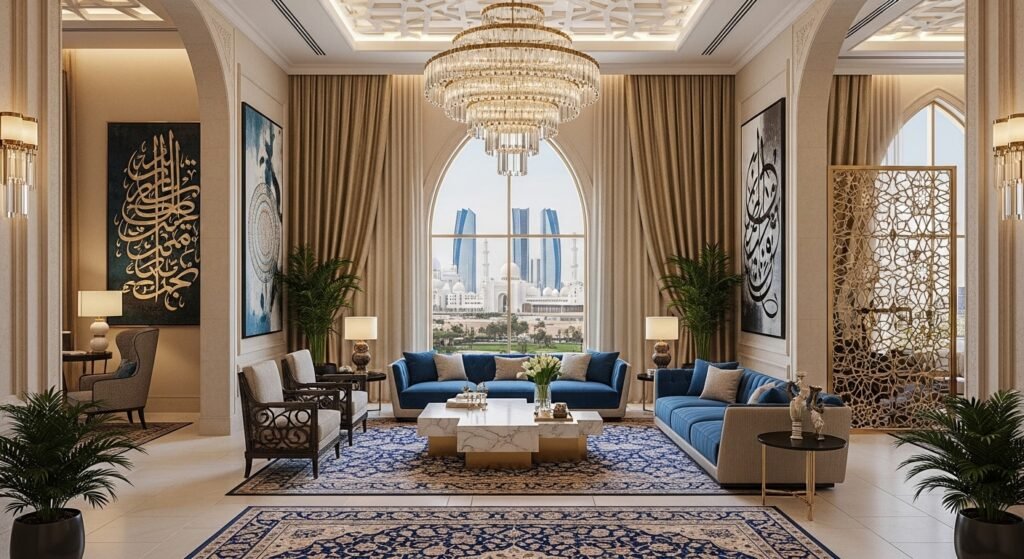
Cultural influences on UAE interior design reach across materiality, spatial hierarchy, and hospitality. Arabic geometric patterns, used in traditional architecture for centuries, now appear as laser-cut metal screens, carved gypsum panels, or printed textiles in contemporary interiors. Warm amber and terracotta tones drawn from desert landscapes remain relevant color references. Oud-inspired fragrance areas, prayer room allocations within residential floor plans, and dedicated guest reception spaces all reflect the social values of Emirati and Arab households.
Natural light filtered through patterned screens creates an atmosphere that changes through the day, a quality that many homeowners in Abu Dhabi actively seek from their designers.
Integrating Majlis and Traditional Elements into Contemporary Spaces
The majlis is the formal reception room of an Arab home, traditionally a separate space reserved for guests, conversation, and hospitality. In contemporary residential interior design, the majlis retains its function but adopts modern form. Low-profile seating arranged around the room perimeter, with cushions in high-quality fabric and a central coffee service point, can sit alongside clean architectural lines without losing cultural meaning.
Designers working in Abu Dhabi frequently handle requests to include a dedicated majlis that also reads as a modern lounge for international clients or dual-culture households. The solution lies in materiality and scale: a coffered or patterned ceiling, bespoke built-in seating with concealed storage, and carefully chosen lighting create the social atmosphere of a traditional majlis within a contemporary floor plan.
Residential Interior Design Abu Dhabi and Commercial Interior Design Services in UAE
Interior design services in Abu Dhabi and across the UAE cover two broad categories: residential projects for homeowners and property investors, and commercial projects for businesses, developers, and hospitality operators. Both categories demand distinct expertise, regulatory awareness, and project management approaches.
Services for Villas, Apartments and Homes
Residential interior design in Abu Dhabi spans the full property spectrum, from studio apartments in Al Reem Island to sprawling villas in Saadiyat Island and Al Bateen. Services cover space planning, material and finish selection, custom furniture and joinery design, lighting design, window treatment, and complete project management through to handover.
Apartment interior design focuses on maximizing floor area, storage efficiency, and visual openness within fixed structural boundaries. Villa interior design operates at a larger scale, coordinating across multiple floors and outdoor spaces while ensuring each room holds its own character. Luxury interior design projects at the high end often include bespoke furniture sourcing, imported material specification, and coordination with specialist artisan contractors.
Renovation and space makeover services allow homeowners to update an existing property without a full structural overhaul, targeting finishes, furnishings, and layout adjustments that shift the feel of a space.
Office, Retail and Hospitality Projects Across UAE
Commercial interior design services in UAE address a wide range of project types with distinct functional requirements. Office interior design covers workspace planning, ergonomics, acoustic management, and brand alignment across corporate headquarters, co-working spaces, and government offices. Retail interior design focuses on customer flow, product display hierarchy, lighting for merchandise, and brand-consistent material selection.
Hospitality projects, including restaurants, cafes, and hotel interiors, require the closest coordination between design intent and operational reality. Kitchen workflow, acoustic comfort for diners, durability of finishes under heavy footfall, and the alignment of visual atmosphere with the intended customer experience all carry equal weight. Designers working across the UAE must also account for Abu Dhabi Municipality and Dubai Development Authority guidelines that apply to commercial fit-outs, including fire egress, accessibility standards, and material safety certifications.
Sustainable Interior Design Practices in Abu Dhabi and Estidama Guidelines
Sustainable interior design in Abu Dhabi operates within a formal regulatory framework that goes beyond general environmental awareness. Abu Dhabi established the Estidama program through the Abu Dhabi Urban Planning Council to govern sustainability across building and interior design projects in the emirate.
Guidelines for Sustainable Interior Design in Abu Dhabi
The guidelines for sustainable interior design in Abu Dhabi under the Estidama framework apply to new constructions and major renovations. Designers and clients working on projects subject to Abu Dhabi Municipality approval need to account for material sourcing, energy consumption, indoor air quality, and water use from the earliest design stages. Using low-VOC paints and adhesives, specifying materials with verified environmental credentials, and designing for natural ventilation where building orientation allows are all standard considerations under these guidelines.
At the fit-out level, choosing durable, long-lasting materials reduces replacement cycles and the embodied carbon associated with repeated refurbishment. This is not only an environmental consideration; it also makes long-term financial sense for property owners in Abu Dhabi.
Estidama Requirements and Four Pillars for Interiors
Estidama is Abu Dhabi’s sustainability rating system, administered by the Abu Dhabi Urban Planning Council. It evaluates projects across four pillars: environmental quality, social quality, economic quality, and cultural quality. The Pearl Rating System, which sits within the Estidama framework, assigns Pearl ratings from 1 Pearl to 5 Pearls based on a project’s performance across these pillars.
For interior designers, the most directly relevant requirements relate to indoor environmental quality, including lighting levels, ventilation rates, acoustic performance, and material emissions. Projects seeking Pearl 2 rating or above, which is mandatory for all new residential and commercial buildings in Abu Dhabi under current regulations, must meet minimum standards in each pillar. Designers who understand the Pearl Rating System can specify materials and systems that satisfy regulatory requirements from the outset, avoiding costly revisions later in the project.
How Much Does Interior Design Cost in the UAE: Budgeting and Pricing Factors
Interior design costs in the UAE vary across a wide range depending on project scope, property size, finish grade, and the service model of the firm you engage. Getting a realistic budget framework before approaching designers saves time and helps you assess proposals accurately.
Realistic Pricing Ranges for Different Project Types
The table below reflects approximate market ranges for interior design projects in Abu Dhabi and the UAE as of 2026. These figures cover design fees and fit-out execution costs together, as most full-service firms price them as a combined package.
| Project Type | Approximate Price Range (AED) |
|---|---|
| Studio / 1-bedroom apartment | 40,000 – 90,000 |
| 2-3 bedroom apartment | 80,000 – 200,000 |
| 4-5 bedroom villa (standard) | 200,000 – 500,000 |
| Luxury villa (full fit-out) | 500,000 – 1,500,000+ |
| Small office (up to 100 sqm) | 60,000 – 150,000 |
| Restaurant / cafe fit-out | 150,000 – 600,000+ |
| Retail space | 80,000 – 300,000 |
These ranges are indicative. A firm quoting at the lower end for a luxury villa project may be excluding custom furniture, imported materials, or project management. Always request an itemized scope of works alongside any price proposal.
Factors That Affect Total Cost in Abu Dhabi
Several variables move the final cost of an interior design project significantly. Material grade is the largest single factor: the difference between locally sourced stone and Italian marble, or standard joinery and bespoke cabinetry, can double a budget on its own. Property size scales cost proportionally, but irregular floor plans, high ceilings, and challenging access in some Abu Dhabi towers or older villas also add complexity.
The scope of structural work matters, too. A cosmetic refresh of finishes and furnishings costs far less than a project that reconfigures walls, moves plumbing, or replaces electrical systems. Designer fees vary between firms; some charge a percentage of the total project value, others use a fixed fee or a per-square-meter rate. Asking for clarity on the fee structure upfront prevents misalignment later. Import lead times for furniture and materials can also affect project duration and therefore contractor costs, particularly when items ship from Europe or Asia.
How to Choose an Interior Designer in Abu Dhabi: Checklist and Red Flags
Choosing the right interior designer in Abu Dhabi requires more than reviewing a portfolio. The right firm needs local regulatory knowledge, a clear process, and a communication style that matches how you want to work.
Step-by-Step Questions to Ask Before Hiring
A structured approach to how to choose an interior designer in Abu Dhabi reduces the risk of misalignment and protects your budget.
Before the first meeting, prepare these questions:
- Does the firm hold a valid trade license issued by Abu Dhabi Department of Economic Development or the relevant free zone authority?
- Can they provide a portfolio of completed projects in Abu Dhabi, not just UAE-wide or international work?
- Do they offer 3D visualization before any physical work begins?
- Who manages the project on a day-to-day basis, and will you have a single point of contact?
- What does the fee include, and what does it exclude?
- How do they handle contractor selection and site supervision?
- What is the payment schedule, and how are changes to scope priced?
- Can they provide references from clients with similar project types?
Asking these questions at the first consultation clarifies competence, process, and fit before any contract is signed.
Warning Signs and How to Verify Local Expertise
Red flags in the designer selection process are worth knowing before you commit. Avoid firms that cannot show completed Abu Dhabi projects in their portfolio; a firm with only Dubai or overseas experience may not understand Abu Dhabi Municipality permit requirements or the Pearl Rating System obligations that apply to your property.
Be cautious of proposals with no detailed scope of works. A price without a defined scope of works creates space for scope creep, disputes, and cost overruns. No written contract, or a contract that lacks a change management clause, is another warning sign worth taking seriously.
Verify that the firm or its lead designers hold current professional credentials. Ask whether they carry professional indemnity insurance. Check online reviews across Google and relevant UAE business directories. Established firms with a real project history in Abu Dhabi will have a verifiable track record that matches what they present in meetings.
Interior Design Company Services and Process in the UAE
A professional interior design company in the UAE delivers more than drawings and furniture selections. The full service model coordinates design, procurement, contractor management, and handover under a single project structure so that clients are not managing multiple vendors independently.
End-to-End Workflow from Concept to Completion
The interior design process in the UAE follows a defined sequence across reputable firms. The project opens with a brief and site assessment, where the designer documents dimensions, existing conditions, client lifestyle requirements, and budget parameters. A concept design phase follows, producing mood boards, spatial layouts, and material palettes for client review and approval.
After concept sign-off, the design moves into detailed drawings: technical floor plans, elevations, joinery drawings, and lighting schemes that contractors use to price and execute the work accurately. Procurement runs alongside the detailed design phase for items with long lead times. On-site execution begins once permits are in place, with the design firm supervising contractor work against the approved drawings. The process closes with a snagging review and final handover, confirming that every element meets the agreed specification.
Role of 3D Visualization in Avoiding Surprises
3D interior design visualization allows clients to walk through a photorealistic rendering of their space before a single material is purchased or a wall is touched. This step prevents the most common source of dissatisfaction in interior projects: the gap between what a client imagined from a mood board and what actually gets built.
Visualization also has a practical cost benefit. Changes made at the 3D stage cost nothing beyond designer time. Changes made after procurement or during construction carry real financial consequences. Firms that include 3D rendering as a standard part of their process demonstrate a commitment to client clarity and reduce the likelihood of revisions once execution begins.
Why Next Interior Design Works for Abu Dhabi Projects
Next Interior Design is an Abu Dhabi-based interior design studio serving homeowners, business owners, and property developers across the emirate and wider UAE. With 120+ completed projects across villas, apartments, offices, and commercial spaces, the studio manages every stage from concept design through to final handover.
What sets the studio apart:
- Deep local knowledge of Abu Dhabi architecture, culture, and lifestyle requirements
- End-to-end project management: one team, one point of contact, from brief to completion
- 3D visualization included before any physical work begins, so you approve the space before it is built
- Certified designers combining creative skill with technical and regulatory knowledge
- Premium, durable materials specified for Abu Dhabi’s climate and long-term performance
- On-time delivery backed by structured project management at every phase
- Fully customized designs: no template approaches, no off-the-shelf solutions
- Services cover residential (villas, apartments, penthouses), commercial (offices, retail, restaurants), renovation, and luxury fit-outs
Book a free consultation by calling +971 52 278 7404 to discuss your project.
Frequently Asked Questions
What are the latest trends in interior design in Abu Dhabi?
The dominant trends in 2026 are warm neutral palettes with natural textures like travertine and linen, biophilic design elements such as indoor plants and natural stone, and architectural zoning that divides open-plan spaces without added walls. Climate-adapted material choices and art-led focal points are also a strong presence in Abu Dhabi homes.
How much does interior design cost in the UAE?
Costs range from around AED 40,000 for a studio apartment to over AED 1,500,000 for a full luxury villa fit-out. Apartment projects mid-range between AED 80,000 and AED 200,000. Material grade, project scope, structural changes, and designer fee structure are the main variables that move the total cost up or down.
How to select the right interior designer in UAE?
Confirm the firm holds a valid Abu Dhabi or UAE trade license, review completed local projects specifically, and ask for a detailed scope of works with an itemized fee structure. Request references, confirm 3D visualization is included, and verify who supervises the site daily. A contract with a clear change management clause protects both sides.
Start Your Interior Design Project in Abu Dhabi
This overview of interior design in Abu Dhabi and UAE covers the key decisions every homeowner, business owner, or developer faces: understanding the current design climate, respecting cultural context, meeting Estidama sustainability requirements, setting a realistic budget, and choosing a qualified local firm with a clear process.
The gap between a finished property and a genuinely well-designed space comes down to the quality of the people you bring in at the start. Next Interior Design has completed 120+ projects across Abu Dhabi and brings the local knowledge, process discipline, and design skill to close that gap for your project. Call +971 52 278 7404 for a free consultation.
—